The Fragmentation Problem: How Point Solutions Create Security Blind Spots
The alert hits at 2:47 PM: sensitive customer data detected in an AI interaction.
Your security team knows what happened. They don't know why.
Was this an employee preparing for a customer meeting? A careless mistake? An early signal of insider risk? Without context, every response is a gamble—either overly aggressive (disrupting legitimate work) or overly passive (missing real threats).
This isn't a tooling failure. It's a visibility failure.
As AI becomes embedded in everyday workflows, security teams are learning a hard lesson: AI cannot be secured in isolation. Detection alone is no longer enough.
The Dual Risk of AI in the Enterprise
Shadow AI: The Known Unknown
Shadow AI remains the most visible concern. Employees routinely use personal accounts or unapproved tools like ChatGPT, Claude, Gemini, or niche AI utilities to get work done faster. These interactions introduce immediate risks like unknown vendors with no contractual protections, zero logging or auditability, no insight into data retention or model training, and complete compliance blind spots.
Organizations have rightly invested in discovering and controlling these tools. But shadow AI is only half the story.
"Approved" AI: The False Sense of Security
The more dangerous risk often hides in plain sight.
Enterprise AI tools like Microsoft Copilot or sanctioned AI coding assistants create an assumption of safety—but approval does not equal appropriate use. The challenge starts with oversharing by design. Employees paste full customer records, financial forecasts, or proprietary code into prompts without hesitation. The tool is approved, so the behavior feels safe.
But AI tools don't understand the difference between public content and unreleased earnings or regulated data. They process everything equally. Meanwhile, these tools can synthesize data from SharePoint, email, and cloud drives, creating new exposure from previously siloed information. The usage might look productive on paper, but the tool itself can't distinguish between summarizing public information and mishandling sensitive data. And critically, AI platforms don't know if the user just accessed 500 sensitive files, is working after hours, or is deviating from normal behavior.
The risk isn't the model. The risk is how humans use it.
Why AI Visibility Alone Falls Short
Most organizations now have some level of AI detection. They know when AI tools are used. But detection immediately runs into a wall.
The "So What?" Problem
An alert fires: content pasted into an AI tool. Now what?
Without context, security teams face impossible choices. They can investigate everything and drown in noise, ignore low-severity alerts and miss real threats, or block aggressively and become the department of "no."
The Intent Problem
Was that customer list pasted into AI because someone is leaving for a competitor—or because they're drafting a legitimate email? AI visibility alone can't answer that.
The Pattern Problem
Is this an isolated incident or part of a broader behavior shift? Are there other signals like unusual file access, declining productivity, or abnormal timing? Point tools see events, not patterns.
The Response Problem
Without context, responses are binary: allow or block. Real security requires nuance—warn, guide, monitor, or intervene based on actual risk.
Security teams don't just need to know that AI is being used. They need to understand why, in what context, and with what surrounding risk signals.
The Point Solution Trap
The market responded to AI risk with speed—and fragmentation. Each category of tool brings value, but all leave dangerous gaps.
AI Detection & Governance Tools
These solutions excel at identifying AI tools, managing allow/deny lists, and applying AI-specific policies. But they're completely blind to file access before and after AI usage, user behavior patterns, insider risk indicators, and what happens outside the AI session. They see the AI interaction—not the environment around it.
Traditional DLP and CASB
Data loss prevention and cloud access security brokers are strong at data classification, policy enforcement, and compliance controls. But they struggle with AI-specific workflows, prompt-level visibility, AI usage analytics, and endpoint activity outside cloud paths. They protect data—but often miss how AI actually touches it.
Insider Risk Platforms
Behavioral monitoring platforms bring strength in tracking file lineage and conducting post-incident investigations. But they're weak at AI visibility, real-time intervention, and understanding AI-driven workflows. They explain incidents—after they've already happened.
The Shared Gap
No category connects AI usage, file access, user behavior, data movement, and productivity signals into a single forensic narrative. Security teams are left correlating alerts across dashboards, timelines, and exports—manually stitching together the truth after the fact.
The Unified Approach: Visibility Plus Context
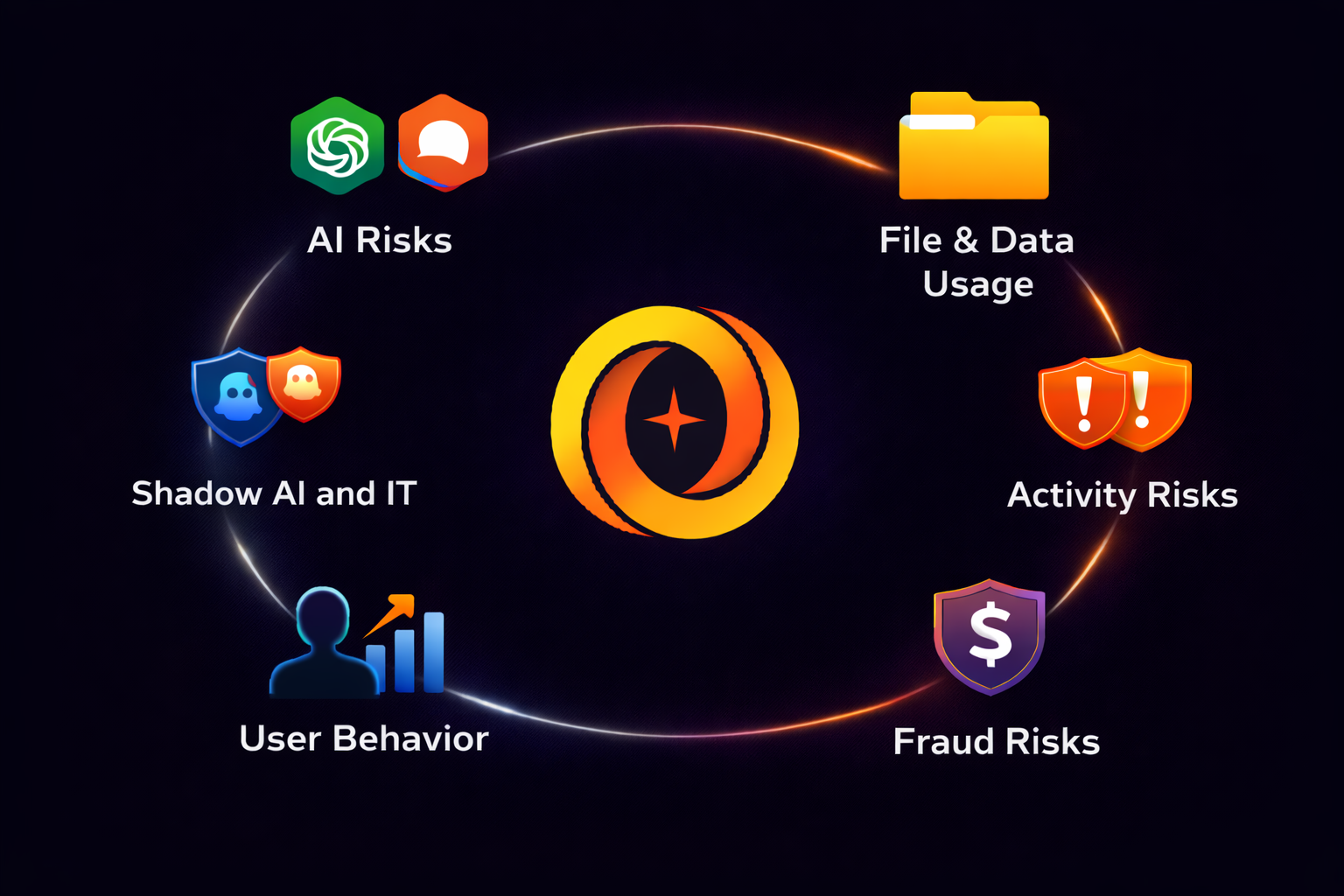
Effective AI security requires a shift in thinking. AI is not a standalone risk. It's one signal inside a broader behavioral system.
InnerActiv was built around this reality.
Full Endpoint Visibility: AI Plus Everything Else
InnerActiv monitors all endpoint activity, including approved and shadow AI usage, browser and native applications, file access and modification, copy/paste and data movement, network transfers and storage access, plus both cloud and local workflows. When an AI alert fires, the surrounding context is already there—no tool hopping required.
Behavioral Context: Understanding the "Why"
Every AI interaction is viewed inside a timeline. Before the interaction, we track what files were accessed, whether the behavior was normal, and if the user searched for sensitive data. During the interaction, we capture what entered the AI tool, how much, how fast, and whether this was iterative problem-solving or bulk transfer. After the interaction, we monitor where outputs went—were they emailed externally, pasted elsewhere, or deleted?
This turns alerts into stories—not guesses.
Real-Time, Risk-Aligned Intervention
With context, responses become precise. Security teams can provide education for honest mistakes, warnings for risky deviations, monitoring for gray-area activity, and blocking only when risk is critical. Security becomes adaptive instead of disruptive.
Forensics Without Friction
InnerActiv provides a complete timeline in one place, showing endpoint actions, file lineage, AI prompts and responses, network activity, and behavioral shifts. Investigations move from days to minutes—without stitching logs together.
Productivity as Signal, Not Noise
Not all AI usage is risky—much of it is genuinely valuable. InnerActiv correlates AI activity with productivity patterns to separate legitimate efficiency gains from behavior that doesn't align with role, output, or intent. This allows security teams to protect the business without blocking innovation.
One Platform, One Agent, One Source of Truth
InnerActiv provides a single lightweight agent, unified policies across AI, data, and behavior, one console, one alert stream, and one coherent risk narrative. No blind spots. No conflicting tools.
The Reality
AI-only tools see AI. DLP tools see data. Insider risk tools see behavior.
InnerActiv sees all of it together.
In an AI-driven workplace, visibility without context creates noise. Context without real-time action creates delay. Fragmentation creates blind spots.
The organizations that succeed won't be the ones that detect the most AI usage—they'll be the ones that actually understand it.

Two TD Bank Insiders. Two Fraud Schemes. One Massive Blind Spot
Two former TD Bank employees. Two separate fraud schemes. More than $9 million in combined losses. Both prosecuted by the U.S. Department of Justice. Both carried out by insiders who had every right to be in the systems they abused.

Intent Is Not a Security Control
A new study from BCG and Columbia Business School found a 51-percentage-point gap between executives and individual contributors on whether employees feel informed about their organization's AI strategy. Leadership thinks the message landed. Employees largely haven't heard it.