AI Is Transforming Work, But the Biggest Risk Is What You Can't See
AI has become the new engine of enterprise productivity. Teams use AI to write faster, analyze deeper, brainstorm smarter, and automate work that once required hours. Businesses feel the upside immediately: faster decisions, reduced manual tasks, sharper insights, and clear productivity gains.
But alongside this acceleration, a fundamental question now hangs over every CISO, CIO, COO, and board: "What is happening with AI in my organization that I can't see?"
Because the truth is simple: AI is being used across your workforce every day, far more than your tools detect. And the greatest risks come from the activity that happens outside your visibility.
This is the core security challenge of the AI era. And it's exactly why InnerActiv has evolved its platform to close this visibility gap with real-time intelligence, risk insight, and productivity metrics straight from the endpoint.
The Hidden Crisis: AI Usage Is Unavoidable but Practically Invisible
Enterprises already know AI adoption is exploding. What they don't know is:
- Which tools or models employees are actually using
- What data is shown on screen when AI tools are active
- What users paste, type, or expose during AI interactions
- Which activities improve productivity, and which create risk
- Where Shadow AI tools are operating out of sight
- When AI agents are performing actions autonomously
- Whether AI is helping certain teams or slowing others down
Without visibility, leaders are left managing AI with guesswork.
New AI Exposure Risks Traditional Tools Can't Detect
AI introduces entirely new exposure risks that traditional tools simply weren't built to detect:
Screen-based exposure: Sensitive information viewed while an AI tool is open can be captured or transferred in ways legacy controls don't monitor.
Clipboard and content-level exposure: Even small amounts of text moved into an AI model can create significant data leakage risk.
Local model and Shadow AI usage: Small models and unapproved tools operate off-network, out of compliance, and outside monitoring.
Agentic AI behavior: Autonomous AI actions blur the line between user intent and machine execution.
Lost productivity signals: Executives know AI is boosting output, but measuring productivity begins with understanding how and who in your workforce is using AI. Only then can you begin to measure productivity gains and guide those who are not using it or could be using it more effectively.
All of this creates a massive blind spot. And blind spots lead to two simultaneous problems:
- Security risk increases because sensitive data enters AI tools without oversight
- Productivity opportunities are lost because organizations lack the baseline metrics to understand AI adoption patterns and impact
When you can't see AI, you can't govern it, and you also can't optimize it.
InnerActiv solves this problem by bringing real-time AI visibility, governance, and productivity intelligence directly to the endpoint, where AI activity actually happens.
How InnerActiv Closes the AI Visibility Gap: The AI Governance Loop
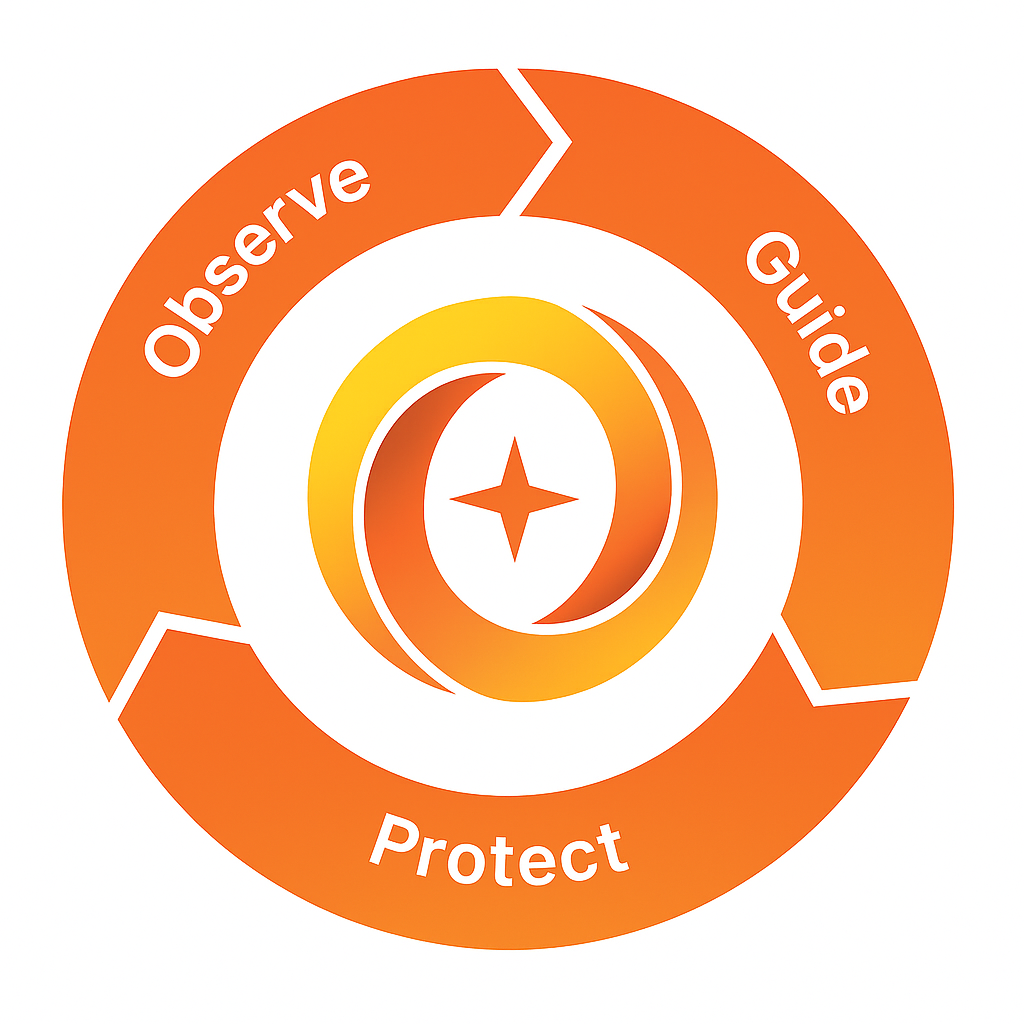
InnerActiv has expanded its platform around a framework called the AI Governance Loop™: Observe, Guide, Protect.
This loop happens where AI activity actually occurs: on the endpoint, in the user's real workflow, in the moment. This endpoint-first approach is essential because AI behavior does not flow through traditional security channels.
InnerActiv works with all browsers, requiring no special browsers or plugins. The platform delivers quick time to install and rapid time to value, with no interruption to your employees' workflow. If employees begin to do something potentially harmful, InnerActiv can guide them appropriately in the moment.
1. OBSERVE: See the Full Picture of AI Use and Its Impact
InnerActiv gives organizations real-time visibility they have never had before:
AI Visibility
- All AI tools, models, and agents in use
- Shadow AI and unmanaged applications
- Local small models running off-network
- Continuous insight into AI workflows
Data Exposure Signals
- When sensitive content appears on screen
- When content is moved into AI models
- When user behavior deviates from normal patterns
Productivity Intelligence
- Understanding how and who in your workforce is using AI
- Which teams or individuals gain the most from AI adoption
- How AI accelerates specific workflows
- Where AI isn't being used effectively
- Where opportunity gaps exist for broader AI adoption
- Real-time trends across departments and roles
This visibility transforms AI from a risk black box into a measurable, governable, and optimizable asset. Because you cannot protect, or improve, what you cannot see.
2. GUIDE: Helping Employees Use AI Safely and Effectively
Most AI risk today comes from well-intentioned employees simply moving too fast. InnerActiv adds a safety layer in the moment of use, without disrupting workflow, through:
Contextual Nudges: Gentle prompts that remind users of potential sensitivity or risk as it happens.
Justification Requests: Quick confirmations that ensure AI actions align with business purpose.
On-Screen Guardrails: In-line guidance that helps users choose compliant workflows without slowing their progress.
Behavioral Reinforcement: Employees learn safe AI habits naturally through real-time interaction, not after-the-fact training.
This approach keeps productivity high while dramatically reducing accidental exposure. Employees continue working seamlessly, with guidance appearing only when needed.
3. PROTECT: Real-Time Controls Built for the AI-Driven Workplace
When AI interactions introduce meaningful risk, InnerActiv enables targeted, context-aware protective actions such as:
- Preventing sensitive content from flowing into AI tools
- Elevating alerts when AI exposure risk appears on screen or in workflow behavior
- Adjusting risk scoring based on anomalous actions
- Escalating policy-driven interventions as needed
- Providing forensic context around the human and AI interaction
Instead of blunt, disruptive blocking, the focus is on precision, context, and protecting data where it is actually at risk.
The Real Threat Isn't AI: It's Not Knowing How AI Is Being Used
AI will continue accelerating across every department and every workflow. Productivity gains will grow. Shadow AI usage will multiply. More tools will embed AI deeply and invisibly.
The organizations that thrive will be those that can answer:
- What AI tools are in use across my workforce?
- What data are employees exposing to these systems?
- How and who in my organization is using AI?
- Where do we need new controls or guidance?
- How do we scale AI safely without stifling innovation?
InnerActiv delivers the real-time insight needed to answer all of them.
InnerActiv's Mission: Help Enterprises Safely Scale AI with Visibility and Confidence
The world of work has changed. AI is no longer optional; it's foundational.
InnerActiv's mission is to ensure enterprises can:
- See how AI is being used across the workforce
- Understand AI adoption patterns to enable productivity measurement
- Detect and prevent data exposure
- Guide employees toward safe behaviors without workflow disruption
- Protect sensitive information in real time
- Govern AI adoption responsibly
- Deploy quickly with no special browsers or plugins required
The biggest threat is what you're not seeing. InnerActiv closes that gap so you can embrace AI with clarity, confidence, and measurable value.

Two TD Bank Insiders. Two Fraud Schemes. One Massive Blind Spot
Two former TD Bank employees. Two separate fraud schemes. More than $9 million in combined losses. Both prosecuted by the U.S. Department of Justice. Both carried out by insiders who had every right to be in the systems they abused.

Intent Is Not a Security Control
A new study from BCG and Columbia Business School found a 51-percentage-point gap between executives and individual contributors on whether employees feel informed about their organization's AI strategy. Leadership thinks the message landed. Employees largely haven't heard it.