RSAC 2026: AI Innovation Is Here. Is Your Organization Ready for What Comes Next?
Every year, RSAC™ 2026 Conference sets the agenda for the cybersecurity industry. In 2026, the conversations happening at Moscone Center aren't just about threats. They're about a fundamental shift in how organizations think about AI, what they're willing to allow, and how they're going to govern what's already running inside their walls.
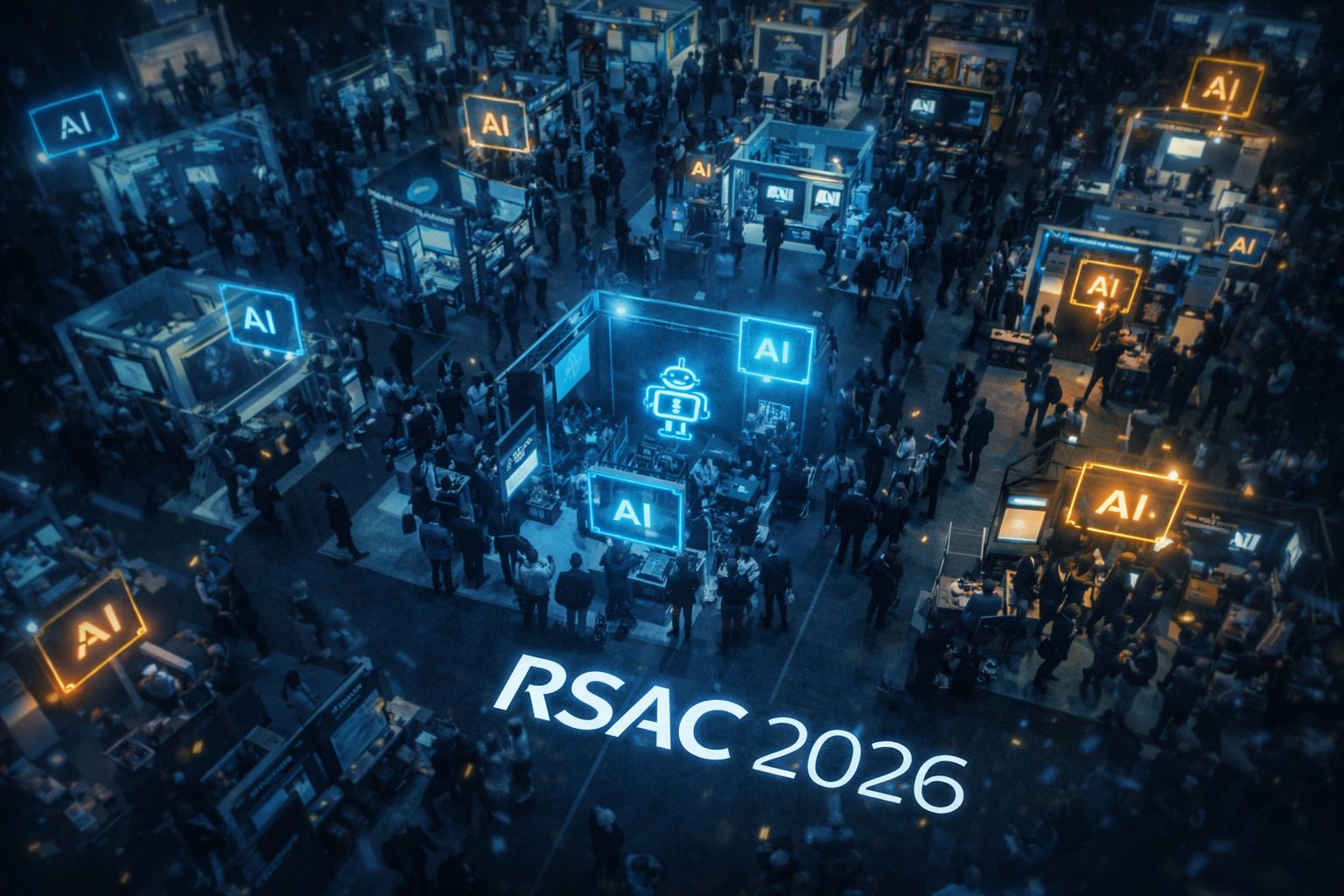
Walk the expo floor at RSAC 2026 and one thing becomes immediately clear: nearly every vendor, in every category, is pitching AI. With over 600 exhibitors on the floor, well over half will have AI prominently featured in their booth messaging, their product demos, and their sales conversations. Some of it is genuine innovation. Some of it is familiar technology with a new label. All of it is heading toward your organization.
This year's theme, "Power of Community," comes at the right time. Because the challenges being surfaced at RSAC 2026 aren't ones any vendor, team, or policy can solve alone.
Here's what's coming, why it matters across every part of your organization, and what you need to have in place before it arrives.
Agentic AI Is No Longer Theoretical
If last year's RSAC was about talking about AI, 2026 is about governing it. Agentic AI, where systems act autonomously to complete tasks, browse data, trigger workflows, and interact with other systems, is moving into production environments at speed. Microsoft, Delinea, Varonis, and dozens of other major vendors are centering their RSAC presence around it.
The sessions reflect the anxiety: "The After Deployment Dilemma: Runtime Reality of AI Agents," "Red Teaming the AI Agent," "Preparing for Next Generation Agentic AI Cybercrime." These aren't theoretical exercises. These are responses to what's already happening in enterprise environments.
Agentic AI introduces a class of identity that most organizations weren't built to govern. An AI agent can request access dynamically, inherit permissions through integrations, interact with other agents outside your control, and operate at machine speed. The challenge isn't whether to allow these tools. Most organizations already have. The challenge is knowing what they're doing once they're inside.
Shadow AI Has a New, More Dangerous Form
The Shadow AI problem didn't go away when companies published AI policies. It got more complex. What started as employees quietly using ChatGPT or Claude to speed up their work has evolved into something harder to see and harder to stop.
Shadow Agents, unapproved AI workflows operating outside any security visibility, are now identified as one of the top data exfiltration risks going into 2026. An employee doesn't need to maliciously download files anymore. They can connect an AI agent to a SaaS tool, give it broad permissions, and walk away. The data moves through automated inference, not traditional file transfers, which means traditional DLP tools miss it entirely.
RSAC 2026 sessions are drawing direct lines between ungoverned AI adoption and board-level risk. Shadow AI is no longer a productivity conversation. It's a security and compliance conversation.
AI Is Coming at Your Organization from Every Direction
It's not one tool, one team, or one use case. AI is being embedded across virtually every software category your employees already use, and it's arriving whether your security team is ready for it or not.
Productivity tools. Microsoft Copilot for M365 is now standard in most enterprise licensing agreements. ChatGPT, Claude, and Gemini are accessible from any browser. Employees are using these tools to draft emails, summarize documents, and analyze data, often pasting in content they shouldn't be sharing outside the organization without a second thought.
Coding assistants. GitHub Copilot, Cursor, and similar tools are accelerating development velocity across engineering teams. They're also ingesting source code, internal documentation, and proprietary logic to generate suggestions. Most developers don't think of that as data leaving the building. It is.
AI-powered security tooling. Your own security stack is increasingly AI-driven. Autonomous SOC platforms, AI-assisted threat detection, and intelligent alert triage are becoming standard. These tools offer real defensive value, but they require clean, complete visibility at the endpoint to function correctly. An AI defense layer built on incomplete data has blind spots by design.
Agentic and autonomous workflow tools. This is the category moving fastest and carrying the most risk. AI agents that can browse, decide, and act autonomously are being wired into business processes across sales, finance, HR, and operations. They don't just answer questions. They take actions, and they can do it at scale, continuously, without a human reviewing each step.
The throughline across all of these categories is the same: most organizations have no systematic way to know which of these tools are running, what data they're touching, or whether they're operating within any defined policy. The tools themselves aren't the problem. The lack of visibility is.
Your Security Tooling Is Getting Smarter. Your Visibility Gaps Aren't Going Away.
AI is transforming how defenders work, and the industry is taking notice. Autonomous SOC workflows, AI-assisted threat hunting, and intelligent alert triage are reducing the time between detection and response. These are real capabilities delivering real value.
But there's a problem that doesn't get enough airtime on the RSAC floor. AI-powered security tools are only as effective as the data they're built on. If your tooling can't see what's happening at the endpoint before data is encrypted and transmitted, the AI layer is working with an incomplete picture. You can have the most sophisticated detection engine on the market and still miss an employee feeding a sensitive contract into a productivity AI tool, because that activity never touches the network layer where most security tools live.
The organizations getting the most out of AI-powered defense have invested in the underlying visibility infrastructure first. The AI is the accelerant. The endpoint data is the fuel.
AI Governance Has Moved from Nice-to-Have to Non-Negotiable
Across RSAC 2026, one message is consistent: governance is no longer in the shadow of compliance. It's a strategic differentiator. Sessions like "The CISO and CIO Mandate for Securing and Governing AI" and "Governance Is Mission Critical: Securing AI in the Era of Geopolitical Competition" signal how seriously enterprise security leaders are taking this.
The governance gap is real. Most organizations allow AI tools without understanding what data those tools are touching or transmitting. Gartner's projection that 40% of AI-related data breaches will stem from misuse by 2027 isn't a scare statistic. It's a forecast based on current adoption behavior.
The organizations that will look back on 2026 as a turning point are the ones that implemented AI governance before an incident forced them to.
What Forward-Thinking Organizations Are Already Doing
The conversation at RSAC 2026 is moving past "should we govern AI" to "here's how organizations that are doing it well have set it up." A few patterns stand out.
They've established endpoint-level visibility. Network-based monitoring and SaaS-layer controls can't see everything. The organizations that are most confident in their AI governance posture have instrumented the endpoint, where AI tools actually run, so they can see what's being passed to which model, what data is leaving, and by whom.
They've built AI policy into their insider risk programs. AI usage isn't a separate workstream from insider risk. The same employee who would exfiltrate data through a USB drive is now just as likely to do it by feeding sensitive documents into an AI model or connecting an autonomous agent to a cloud storage folder. The risk is the same. The vector is new.
They've drawn a line between enabling AI and being blind to it. Blocking AI tools entirely doesn't work and creates its own risks. The organizations that are ahead of this have found a way to allow productive AI use while maintaining the guardrails to catch misuse, data leakage, and ungoverned agent activity before it becomes a breach.
InnerActiv: Built for the Way AI Actually Works
InnerActiv approaches this differently from most of the security industry. While network-based and SaaS-layer tools try to monitor AI from the outside in, InnerActiv operates at the endpoint level, giving organizations pre-encryption visibility into what AI tools are actually doing on the device.
That means security teams can see which AI applications employees are using, what data is being inputted, and where it's going. Not after the fact. In real time.
For organizations trying to enable AI productivity without opening the door to ungoverned data movement, InnerActiv provides the visibility layer that makes AI governance actionable rather than theoretical. The same platform that detects insider risk and data exfiltration extends naturally to AI tool monitoring, AI policy enforcement, and agentic workflow oversight.
You don't have to choose between letting your workforce use AI and knowing what your data is doing. The organizations at the front of that curve already have a platform that makes both possible. That's what InnerActiv is built for.
Attending RSAC 2026? Come find us in the North Expo at Booth N-6559. We'll show you exactly what endpoint AI visibility looks like in practice, live, on real data.
Can't make it to the show? Reach out directly at info@inneractiv.com and let's talk about what AI governance looks like for your organization.

Two TD Bank Insiders. Two Fraud Schemes. One Massive Blind Spot
Two former TD Bank employees. Two separate fraud schemes. More than $9 million in combined losses. Both prosecuted by the U.S. Department of Justice. Both carried out by insiders who had every right to be in the systems they abused.

Intent Is Not a Security Control
A new study from BCG and Columbia Business School found a 51-percentage-point gap between executives and individual contributors on whether employees feel informed about their organization's AI strategy. Leadership thinks the message landed. Employees largely haven't heard it.