Most AI Governance Tools Are Blind at the Moment That Matters
Every AI governance tool on the market right now is watching the wrong thing.
They're watching tools. Domains. Whether the connection went to an approved endpoint. What they're not watching is the person on the other end of it, and whether what that person just did makes any sense given everything you know about them.
That's not a feature gap. That's a wrong turn at the foundation.
AI didn't create new threat vectors. It gave existing ones a makeover. The same behaviors that have always preceded an incident are still there. They just look like productivity now. They pass every policy check. And unless you already have context on that user, that data, and what normal looks like for both, you're not going to catch it.

Browser plugins and proxies were never going to be enough
Here's the visibility problem nobody is talking about plainly enough. A browser plugin sees what happens in the browser. A proxy sees that a connection was made. Process-level monitoring sees that an application ran. None of them see what actually happened, what data moved, what was typed into a prompt, what came back, or whether any of it fits the pattern of someone doing their job versus someone doing something they shouldn't.
That was a limitation worth living with when AI tools were rare and easy to enumerate. It's not a limitation you can live with now. AI is embedded in operating systems, in productivity suites, in developer tools, in applications your security team didn't approve and may not even know about. The perimeter these tools were designed to watch doesn't describe the attack surface anymore.
Insider threat and DLP work taught us this lesson already. You can't govern behavior you can't see. And you can't see behavior from outside the endpoint.
Old problem, new clothes
Insider threat work has always been about behavior, not events. Not "did this person copy a file" but "why is this person copying files they've never touched before, at 11pm, two weeks after a hard conversation with their manager."
That context is everything. Without it you're writing rules and hoping the bad thing fits one of them.
AI didn't change that. It just made the behavior harder to see because now it looks like someone doing their job. The developer feeding proprietary architecture into a coding assistant looks identical to the developer using that same tool to go faster. The employee summarizing customer records in a generative AI tool looks identical to the one drafting a client update. Same actions. Completely different situations. You can't tell them apart without behavioral history, and you can't build behavioral history from a browser plugin.
You can't backfill this
Behavioral context isn't something you turn on. It builds over time. You need baseline before it means anything, and you need it running before the incident, not after.
So if your AI governance strategy is a new tool with no history on your users, no data classification context, no endpoint visibility, you already have a gap. Not a future gap. A current one.
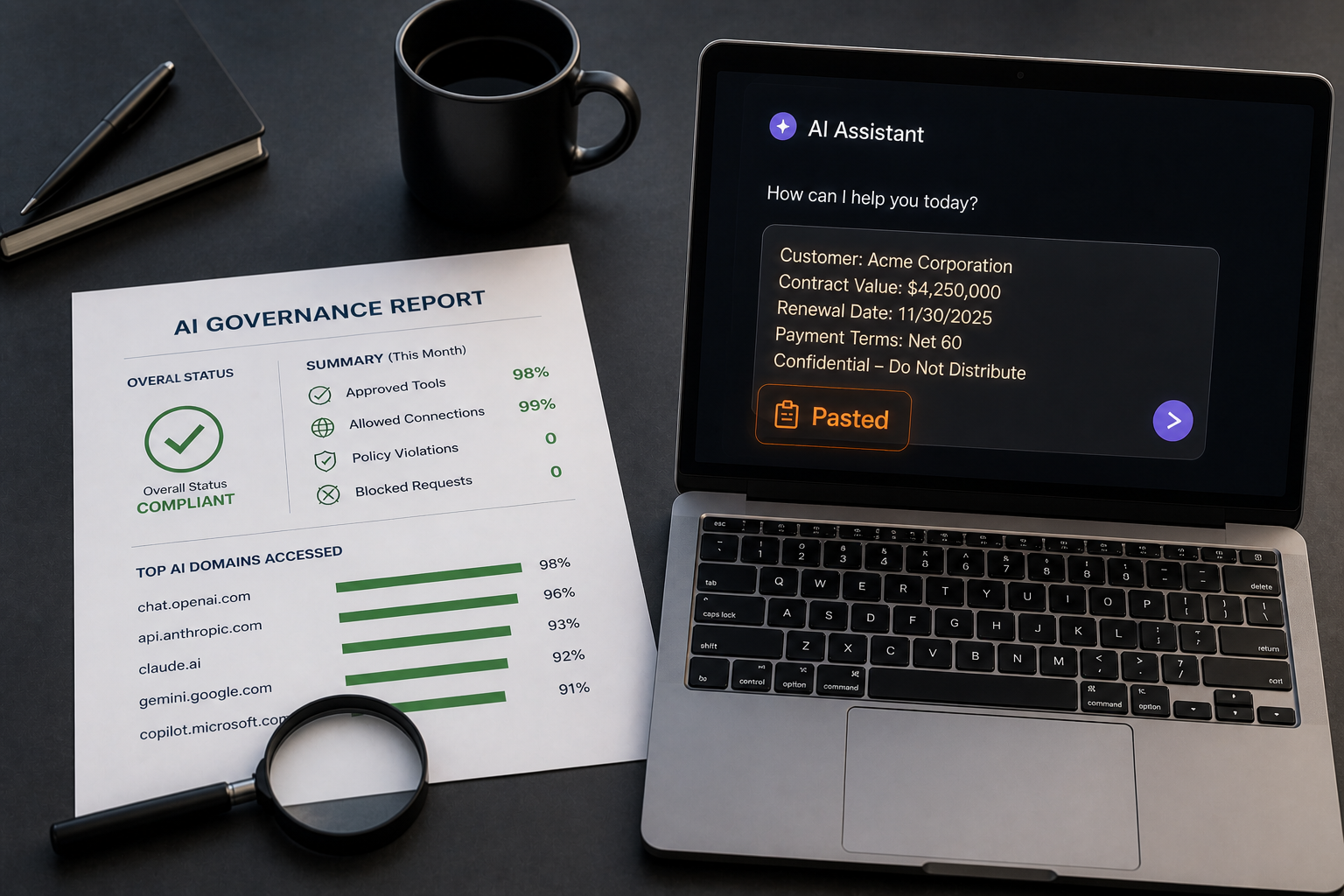
An employee pastes contract language into a generative AI tool. A proxy logs an HTTPS connection to a known AI domain and moves on. Nobody knows what data moved, whether it was sensitive, or whether this person has been doing the same thing every day for two weeks.
A platform with endpoint-level behavioral context sees something different. New tool for this user. Data category with classification flags. Third time in 48 hours. That's not a policy match. That's a pattern.
The threats nobody has written rules for yet
What's out there now is the early wave. Employees aren't just using AI tools anymore. They're building with them, chaining them together, setting up agents that make decisions across multiple systems with minimal human involvement at each step. Every hop in that chain is a potential exposure point, and almost none of them map to anything a policy team has anticipated.
You can't write rules for what you haven't seen.
What you can do is build the visibility and behavioral foundation that makes an unknown pattern recognizable when it shows up. That's what insider threat programs learned to do over decades. That's what real DLP was built on. And that's exactly what's missing from every AI governance tool that's watching the browser instead of the endpoint.
This Is What InnerActiv Was Built For
Most AI governance tools were built for AI. InnerActiv was built for the threat underneath it.
For over a decade, InnerActiv has operated at the endpoint, watching behavior, classifying data in context, and building the kind of user activity baseline that makes an anomaly recognizable before it becomes an incident. That work predates the AI governance market by years. It's also exactly what the AI governance market is missing.
Because InnerActiv governs at the process level, it sees every AI interaction regardless of the tool, the browser, or whether IT approved it. No plugin to deploy. No proxy to route traffic through. No gap between what your employees are doing and what your security team can see.
When a new AI tool appears tomorrow that nobody has heard of yet, InnerActiv already covers it. When an agent takes an action three steps removed from the user who set it up, InnerActiv has the context to evaluate it. When a behavior pattern emerges that no policy anticipated, InnerActiv has the baseline to recognize it as a pattern at all.
That's not a feature. That's the foundation.

Two TD Bank Insiders. Two Fraud Schemes. One Massive Blind Spot
Two former TD Bank employees. Two separate fraud schemes. More than $9 million in combined losses. Both prosecuted by the U.S. Department of Justice. Both carried out by insiders who had every right to be in the systems they abused.

Intent Is Not a Security Control
A new study from BCG and Columbia Business School found a 51-percentage-point gap between executives and individual contributors on whether employees feel informed about their organization's AI strategy. Leadership thinks the message landed. Employees largely haven't heard it.