The AI Risk You Were Warned About Is Already Here
For years, security leaders heard the same predictions: AI would transform the insider threat landscape. Employees would leak sensitive data into unmanaged tools. Attackers would exploit AI integrations to move laterally through enterprise environments.
That future arrived. The numbers confirm it, and so do the breach reports.
The Data Is No Longer Theoretical
Two statistics tell a story that should concern every CISO and IT security professional.
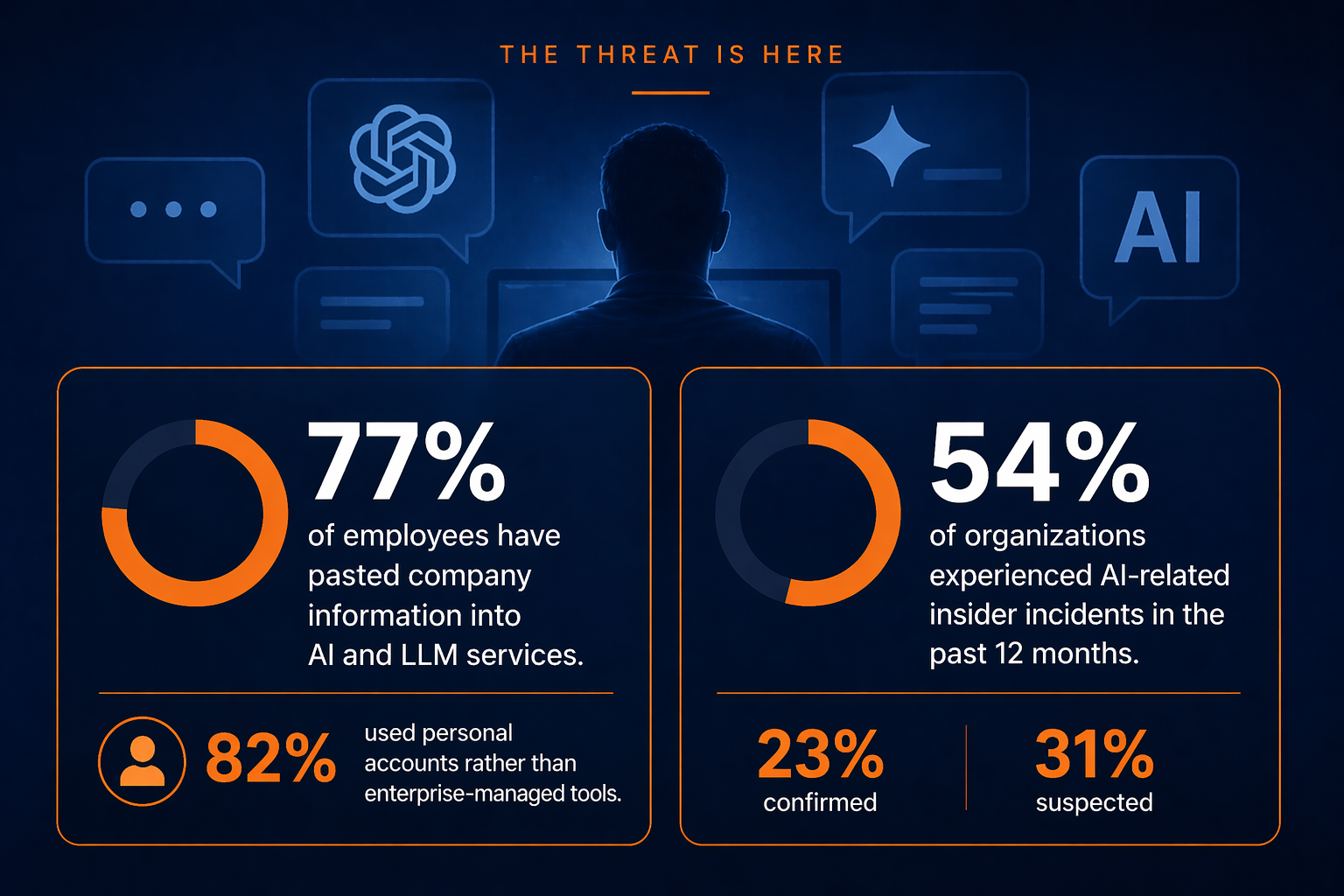
According to the LayerX Enterprise AI & SaaS Data Security Report 2025, 77% of employees have pasted company information into AI and LLM services. Of those, 82% used personal accounts rather than enterprise-managed tools. The overwhelming majority of AI-related data movement in most organizations is happening outside the security team's line of sight.
At the same time, more than half of organizations surveyed by Cybersecurity Insiders (54%) report AI-related insider incidents within the past 12 months. Twenty-three percent confirmed incidents. Another 31% report suspected ones. That is not a future risk. That is active, ongoing exposure.
What "Shadow AI" Actually Looks Like in Practice
The phrase sounds like a niche security concept. The reality is mundane.
An engineer pastes proprietary source code into ChatGPT to debug a problem. A sales rep drops a customer list into an LLM to draft outreach emails. A finance analyst summarizes an acquisition briefing using a personal AI account because the enterprise tool is too slow. None of these employees intend to cause a breach. Most would be surprised to learn they had.
But intent is not the standard regulators or customers apply after the fact. The 82% using personal accounts means that even in organizations with an AI policy, most AI-related data movement is bypassing it entirely. Policies that sit in a handbook with no technical enforcement are not policies. They are aspirations.
The Vercel Incident: When the AI Tool Is the Entry Point
The risk goes beyond employees leaking data outward. AI tools are also becoming entry points for attackers moving inward.
In April 2026, Vercel disclosed a breach that began at Context.ai, an AI platform used by one of its employees. Attackers who compromised Context.ai used that foothold to take over the employee's Google Workspace account and move laterally into Vercel's internal environments. Credentials and a subset of customer data were exposed. The investigation into the full scope of exfiltration is ongoing.
The entry point was not a phishing email or a misconfigured server. It was an AI productivity tool connected to a work identity. Whether that tool was sanctioned by IT remains unclear. Most organizations cannot answer that question quickly, and that ambiguity is the problem.
The Visibility Gap That Sits Under All of This
Security teams are monitoring the tools they know about. The risk is concentrated in the ones they do not.
AI tools require broad permissions to function. They ingest context from email, documents, calendars, and codebases. When one of those tools is compromised, the blast radius reflects everything it had access to. Traditional DLP and network monitoring are not designed to see this. A developer pasting source code into a browser-based AI interface generates no alert. The data moves through what looks like normal activity.
Endpoint-level visibility changes that equation. If you can see what is happening at the process level, before encryption, before data reaches any external service, suspicious AI activity shows up as observable behavior at the source rather than an anomaly at the network edge.
Governance That Exists Only on Paper Is Not Governance
The organizations that will weather this period are the ones treating AI governance as a technical enforcement problem, not a policy writing exercise.
That means knowing which AI tools are running in your environment, sanctioned or not. It means visibility into what data is being passed to those tools. It means identifying when an AI integration starts behaving outside its expected scope before the damage compounds.
Fifty-four percent of organizations have already experienced an AI-related insider incident. The other 46% are either protected or unaware. Given that 66% of organizations still struggle to accurately detect insider threats despite running multiple dedicated tools, "unaware" is the more likely explanation for most.
The prediction window has closed. This is not preparation anymore. It is response.
If you want to see what real-time, endpoint-native AI visibility looks like across sanctioned tools, shadow AI, and the full insider risk surface, talk to the InnerActiv team.

Two TD Bank Insiders. Two Fraud Schemes. One Massive Blind Spot
Two former TD Bank employees. Two separate fraud schemes. More than $9 million in combined losses. Both prosecuted by the U.S. Department of Justice. Both carried out by insiders who had every right to be in the systems they abused.

Intent Is Not a Security Control
A new study from BCG and Columbia Business School found a 51-percentage-point gap between executives and individual contributors on whether employees feel informed about their organization's AI strategy. Leadership thinks the message landed. Employees largely haven't heard it.